Some football matches are about football. This one never has been.
A meeting between the United States and Iran at a World Cup carries a weight that no tactics board can hold and no result can settle. It is a fixture where 22 players are asked to represent not just their teams but the long, fraught history between two governments that do not even maintain diplomatic relations. And in 2026, against the backdrop of an actual war between the two countries, the prospect of them sharing a pitch is more loaded than at any point in the sport's history.
First, the practical reality: it cannot happen early. The United States have been drawn in Group D alongside Paraguay, Australia and Türkiye, while Iran sit in Group G with Belgium, Egypt and New Zealand. The two can only collide in the knockout rounds, which means a meeting would require both to navigate the group stage and the bracket to fall a certain way. It is far from guaranteed. But the mere possibility is enough to dominate conversation, because we have seen this story before.
A Rivalry Written On The World Stage
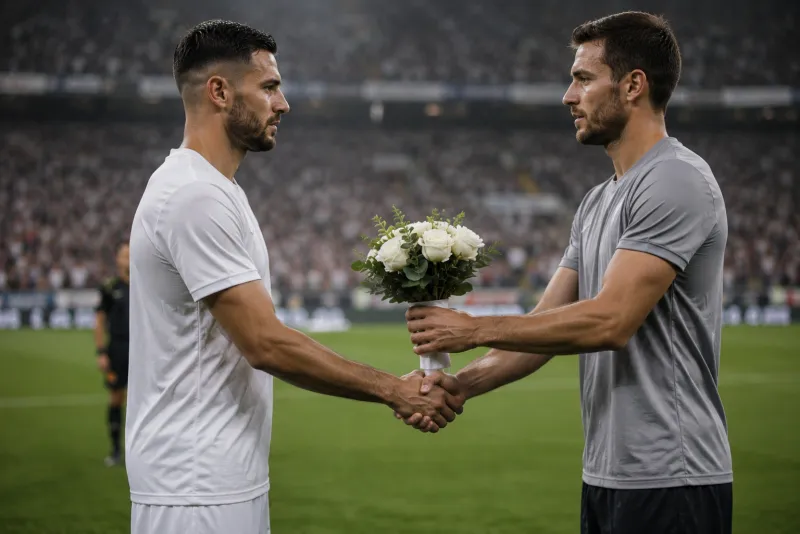
The defining chapter came at the 1998 World Cup in France. Drawn together in Lyon, the United States and Iran played what many still call the most politically charged match in the tournament's history. Mindful of the tension, the players defused it themselves: before kickoff the Iranian team presented their American opponents with white flowers, and the two squads posed together for a joint photograph that traveled around the world. Iran won the match 2-1, a result that sparked jubilant celebrations in Tehran and remains one of the proudest nights in Iranian football.
The teams met again at the 2022 World Cup in Qatar, and this time the stakes were sporting as well as symbolic, with a place in the knockout rounds on the line. The United States won 1-0 through a Christian Pulisic goal, eliminating Iran from the tournament. That meeting carried its own friction, including a dispute over how Iran's flag was briefly displayed and pointed exchanges in the pre-match press conferences. Two games, two wildly different outcomes, and a rivalry that has never been allowed to be simply about the scoreline.
The Backdrop In 2026
What sets this World Cup apart is that the political tension is no longer historical context. According to international reporting, the United States and Israel launched strikes on Iran in late February 2026, triggering a conflict that has rippled across the Middle East and seen repeated rounds of fighting, fragile ceasefires and renewed strikes in the months since. A ceasefire brokered in April has held only intermittently, with both sides trading fire as recently as the days before the tournament. This is not a distant diplomatic chill; it is an ongoing war, with real human cost, unfolding as the teams prepare to play.
That reality has already shaped the tournament off the pitch. The U.S. administration's travel restrictions, which it says are grounded in national security, place Iran among several nations whose citizens are largely barred from entry. The practical consequence is stark: ordinary Iranian fans, who waited years to follow their team at a World Cup, have been shut out of attending matches on American soil. Iran's football federation has objected, framing the visa difficulties as political rather than sporting, and has raised the matter with FIFA. Reports indicate Iran moved its training base to Mexico rather than the United States, and that some of the team's support staff faced visa denials even as players were granted the athlete exemptions that normally apply.
In short, the question is not only whether the United States and Iran would meet, but under what extraordinary circumstances such a meeting would take place at all.
What A Meeting Would Actually Look Like
Expect the football to become almost secondary in the build-up. The match would arrive wrapped in security on a scale beyond even a typical World Cup knockout tie, with the world's media framing it as a geopolitical event first and a sporting contest second. Every gesture, every word in a press conference, every moment of the anthems would be scrutinized for meaning.
For the players, the burden is real and slightly unfair. Footballers are not diplomats, yet they would be asked to carry the symbolism of a conflict they did not choose. History suggests the athletes themselves often handle these moments with more grace than the politics surrounding them: the 1998 flowers and the joint photograph remain the enduring image of that fixture, a reminder that the people on the pitch frequently reach for sportsmanship even when the wider relationship offers none. Whether such a gesture would be possible, or even welcomed, against the backdrop of an active war is one of the heaviest questions hanging over the tournament.
On the field, the contrast in styles would be compelling in its own right. The United States bring a young, athletic, high-pressing side shaped by a generation of players based at Europe's biggest clubs. Iran, perennial qualifiers and one of Asia's most organized teams, tend to defend in disciplined banks and strike on the counter, capable of frustrating more fancied opponents. In a vacuum, it would be a fascinating tactical puzzle. This match, of course, would never be played in a vacuum.
The Limits, And The Value, Of Sport
It is tempting to reach for the comforting cliché that sport can transcend politics. The honest truth is that it cannot, certainly not a war. A 90-minute match will not resolve a conflict, reopen embassies or undo the human suffering taking place far from any stadium. Anyone expecting football to heal what diplomacy has not is asking too much of a game.
But sport can still do something smaller and not insignificant. For one afternoon, two nations with no other shared ground would occupy the same space, watched by the same global audience, bound by the same rules. The players would shake hands. Somewhere, an American and an Iranian fan would, despite everything, watch the same goal and feel the same jolt. That is not peace. It is not a solution. It is simply a rare reminder, amid a grim chapter, that the people of two countries are not the same thing as the quarrel between their governments.
If the bracket delivers it, a United States meeting with Iran will be the most watched, most analyzed and most uncomfortable fixture of the 2026 World Cup. It will be a football match in name. Everyone watching will know it is something far larger than that.
---
This article touches on an ongoing armed conflict and a developing political situation; the facts surrounding the war, ceasefires and travel restrictions were accurate as of early June 2026 and may change. It aims to report the context neutrally, without endorsing the position of any government.