The World Cup does not just decide champions. It anoints icons — the handful of players whose names become shorthand for an entire era of football. Some were born into poverty and lifted a nation; some were lab-perfect athletes priced like small companies. What unites them is the stage: there is nowhere else in sport where greatness is sealed, or denied, quite so completely.
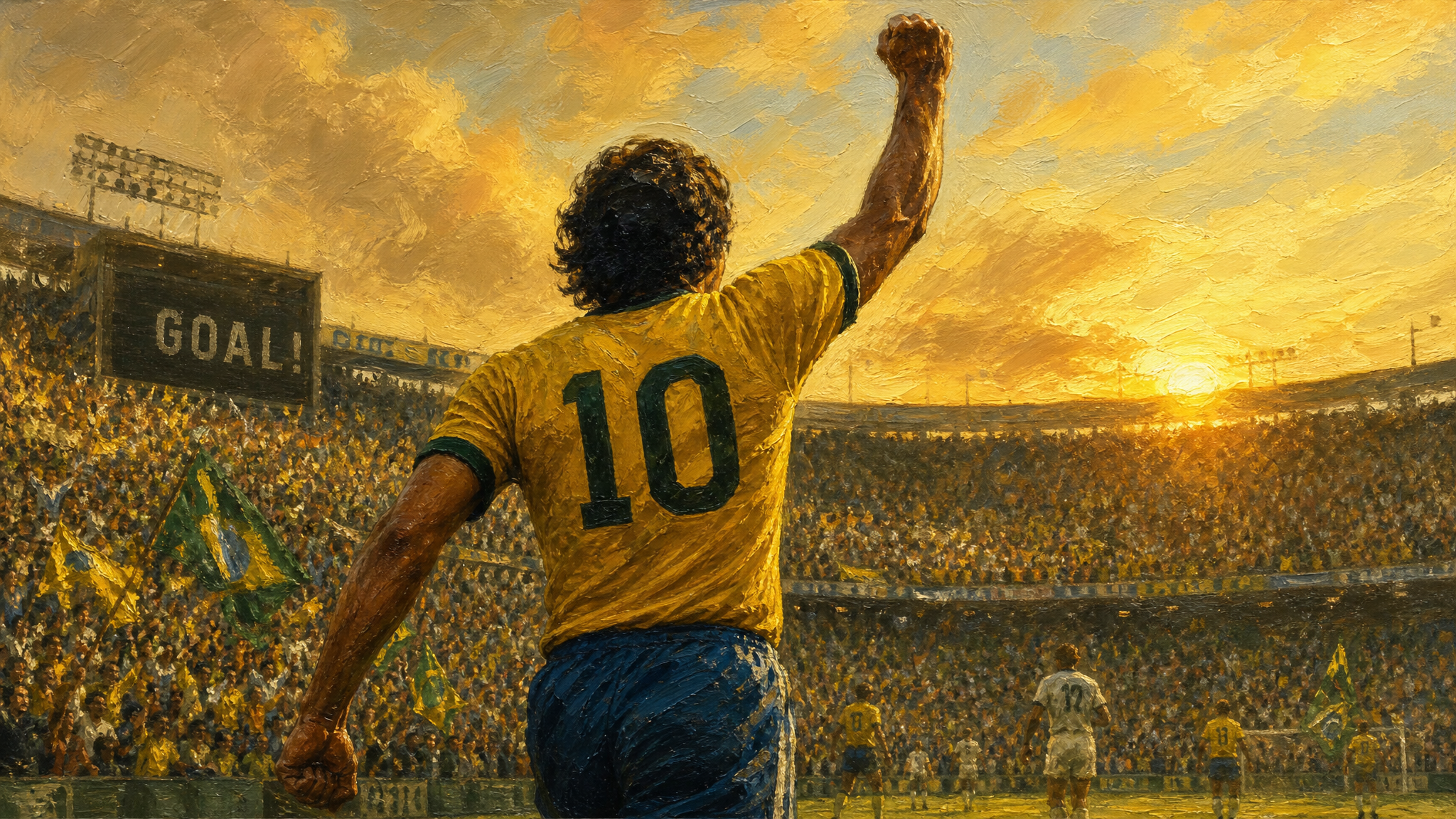
Pelé: the boy king who won it three times
Brazil · 1958 · 1962 · 1970 · 12 World Cup goals
Edson Arantes do Nascimento was born in 1940 into hardship in Três Corações, shining shoes to help his family and learning the game with a ball of rags. By 17 he was a World Cup champion, scoring twice in the 1958 final in Sweden and announcing a talent the sport had never seen. He would win again in 1962 and, most gloriously, in 1970, anchoring a Brazil side still regarded by many as the finest ever assembled. No other player has won three World Cups, and that singular record — more than the goals, more than the highlight reels — is why Pelé remains the founding deity of this pantheon.
Cruyff and Beckenbauer: the men who rebuilt the game
Netherlands & Germany · the 1974 generation
If Pelé was the World Cup's great artist, the 1970s gave it its great thinkers. Johan Cruyff, the brilliant, prickly heartbeat of the Netherlands, never lifted the trophy — his Total Football side lost the 1974 final to West Germany — yet his influence on how football is played, through Ajax and later Barcelona, arguably outstrips any champion's. His opponent that day, Franz Beckenbauer, redefined the defender as a creative force, inventing the modern sweeper and captaining Germany to the 1974 title. "Der Kaiser" later won it again as a manager in 1990, joining the rarest club in the game: those who conquered the World Cup from both the pitch and the dugout.
Maradona: 1986, and a World Cup carried alone
Argentina · 1986 champion · 1990 finalist
Diego Armando Maradona grew up in Villa Fiorito, a shantytown on the edge of Buenos Aires, and turned a difficult, defiant genius into the most personal World Cup triumph the tournament has known. The 1986 edition in Mexico was, simply, his. In a single quarter-final against England he produced both the cynical "Hand of God" and, minutes later, the "Goal of the Century" — a slaloming run past half the team that remains the most replayed solo goal in history. He dragged a modest Argentina side to the title almost by force of will, and returned them to the final in 1990. No player has so completely embodied the idea that one man can win a World Cup.
Pelé won three; Maradona won one — but he made you believe a single player could do it alone.
Zidane and Ronaldo: grace, power, and redemption
France & Brazil · 1998 · 2002 · 2006
The turn of the century belonged to two very different masters. Zinedine Zidane, born in Marseille to Algerian immigrant parents, headed home twice in the 1998 final to give France the trophy on home soil — and bowed out in 2006 with the most infamous moment in final history, a red card for headbutting Marco Materazzi. Across the same years, Brazil's Ronaldo Nazário — "O Fenômeno" — completed one of sport's great comebacks: after a mysterious collapse on the morning of the 1998 final and a series of devastating knee injuries, he returned to score both goals in the 2002 final and finish as that tournament's top scorer. His 15 World Cup goals stood as a benchmark for two decades.
Messi and Ronaldo: two decades, one argument
Argentina & Portugal · 2006–2026 · 13 Ballon d'Ors between them
For the better part of twenty years, football was organised around a single debate. Lionel Messi, the boy from Rosario whose growth-hormone treatment was funded by Barcelona, and Cristiano Ronaldo, the relentlessly self-made forward from Madeira, pushed each other to a level of sustained excellence the sport had never witnessed — and shared thirteen Ballon d'Or awards. The World Cup, for the longest time, withheld its blessing. Then, in 2022, Messi finally completed his story, dragging Argentina to the title and scoring twice in an unforgettable final. At this 2026 tournament he has gone further still, a hat-trick against Algeria drawing him level with Miroslav Klose on 16 goals — the all-time record — with the chance to claim it outright. Ronaldo, for his part, holds his own landmark: the only man to score at five different World Cups, a feat of longevity matched only by Messi himself.
Messi and Ronaldo are the only players in history to appear at six editions — and both are doing it in 2026.
When superstardom became a number
There is a modern twist to the icon's story: today, greatness comes with a price tag, tracked and updated like a stock. Where Maradona's world-record move to Napoli in 1984 cost a few million pounds, the 2026 World Cup features a generation whose valuations dwarf anything that came before. According to market trackers, three players sit at the summit, each valued at around €200 million (roughly $230 million): Norway's Erling Haaland, Spain's Lamine Yamal and France's Kylian Mbappé. Behind them, a cluster of Vinícius Júnior, Pedri, Michael Olise and Jude Bellingham carry valuations once unthinkable for any footballer.
The same market tells the era's other story with brutal clarity. Messi and Ronaldo, the defining stars of the age, now rank hundreds of places down the valuation list — Messi around the 360th most valuable player at his own World Cup. It is no slight; it is simply time. The torch, in cold financial terms, has already passed.
| Player | Nation | Value |
|---|---|---|
| Erling Haaland | Norway | ~€200M |
| Lamine Yamal | Spain | ~€200M |
| Kylian Mbappé | France | ~€180–200M |
| Vinícius Júnior | Brazil | ~€150M |
| Pedri | Spain | ~€150M |
| Michael Olise | France | ~€150M |
| Jude Bellingham | England | ~€140M |
Figures via Transfermarkt, mid-2026; market values shift constantly with form, age and contracts.
Who walks away an immortal?
2026 · The Names to Watch
This is the tournament where the next chapter gets written. Here is how Pitch Chronicles reads the race for history as the knockouts approach.
Lionel Messi — one goal from forever
At 38, Messi needs a single strike to stand alone as the World Cup's all-time leading scorer, having already matched Klose. With Argentina among the favourites and several matches potentially still to come, the smart money says the record falls. It would be the perfect coda to the most decorated career the game has known.
Kylian Mbappé — the heir, accelerating
Already a 2018 world champion and the man who scored a hat-trick in the 2022 final, Mbappé opened his 2026 account by becoming France's all-time leading scorer. On 14 World Cup goals at just 27, he is the most likely man to one day eclipse both Messi and Klose — and a strong tournament could put the all-time record within his reach far sooner than expected.
Erling Haaland — the debutant phenomenon
The world's most valuable player finally has his World Cup stage, and he marked his long-awaited debut with a brace. If Norway's supporting cast can carry him deep into the tournament, the Golden Boot — and a first piece of World Cup silverware — is well within range for a striker who scores at a rate few in history have matched.
Lamine Yamal — the teenager who could steal it all
At the other end of the age scale sits the most intriguing name of all. Spain's Yamal, the youngest player ever to top the global market, has the chance to do what Pelé did in 1958 and Mbappé did in 2018: announce himself to the world as a teenager and leave as a champion. If any player can turn 2026 into the start of a new dynasty, it is him.
The beauty of the World Cup is that none of this is settled. A tournament that turned a barefoot teenager into a king and a kid from a Buenos Aires shantytown into a god is perfectly capable of crowning someone no one expected. By the time the final whistle sounds in New Jersey on 19 July, football will have a new name to argue about for the next four years — and quite possibly, the next forty.