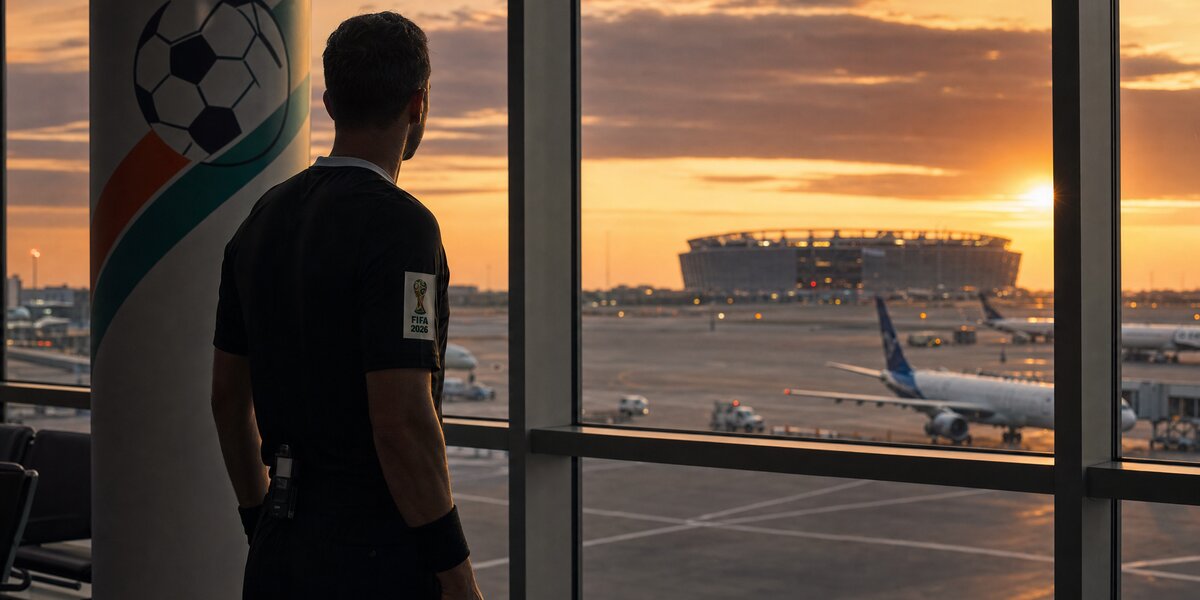
The World Cup is meant to be football's great unifier — a tournament where borders dissolve and the global game speaks its only universal language. But on Saturday, at Miami International Airport, that ideal collided with the cold reality of American immigration enforcement.
Omar Artan, Somalia's sole representative among the 2026 World Cup's officiating roster, was denied entry into the United States after arriving on a flight from Istanbul. U.S. Customs and Border Protection confirmed the decision Monday, citing standard admissibility protocols without disclosing specific reasons. FIFA followed hours later with a terse statement acknowledging that Artan "wouldn't be able to train and officiate at the World Cup."
A Blow to Representation
This isn't merely a logistical inconvenience. Artan's exclusion strips the tournament of one of its most symbolically important officials. In a competition that preaches diversity across 16 host cities — from the towering Estadio Azteca in Mexico City to the gleaming SoFi Stadium in Los Angeles — and 48 participating nations, the absence of a referee from the Horn of Africa stings with particular cruelty. East Africa, a region already vastly underrepresented in football's corridors of power, loses its lone voice on the pitch.
Artan's rise to the World Cup stage was itself a testament to perseverance. The Confederation of African Football (CAF) has long championed his development through its elite refereeing pathway, and his appointment to the global showpiece was celebrated across the continent as recently as last month, when he officiated the CAF Champions League final between AS FAR Rabat and Mamelodi Sundowns in Morocco. That assignment was widely seen as a dress rehearsal for his World Cup duties.
FIFA's Quiet Crisis
Behind the diplomatic language, FIFA officials are privately concerned. The governing body has invested heavily in positioning World Cup 2026 as the most inclusive edition in history — expanding to 48 teams, spreading matches across three nations, and promising unprecedented representation from every confederation. Having a match official turned away at the border, days before the opening ceremony at Estadio Azteca, is precisely the kind of geopolitical headache Gianni Infantino's administration did not need.
"Despite the circumstances, I am in a positive mood and I am focused on the next challenges in my refereeing career," Artan said in a statement released through FIFA. "I would like to thank FIFA and CAF for all their support and I promise to keep my refereeing levels up as I concentrate on the future. I want to thank the football family for their messages and wish my colleagues all the best success during the World Cup."
The graciousness of Artan's response — notably lacking any direct criticism of the United States — belies the uncomfortable questions now swirling around the tournament's host nation. If a FIFA-accredited official with verified credentials and a defined role in the competition cannot gain entry at a major international airport, what message does that send to the hundreds of thousands of fans expected to travel from Africa, the Middle East, and beyond?
The Bigger Picture
The incident is not without precedent. International sporting events hosted in the United States have long navigated the tension between stringent border policies and the practical demands of global participation. But the stakes at a World Cup — particularly one co-hosted across the United States, Mexico, and Canada, with the final set for MetLife Stadium in New Jersey — are exponentially higher than any Olympics or regional championship.
FIFA has not yet announced whether a replacement official will be appointed from the reserve list, nor has the organization clarified whether it will seek formal intervention from the U.S. State Department. The clock is ticking. With group stage fixtures set to commence within weeks, the referee pool is already stretched across training camps and pre-tournament briefings in Dallas, Atlanta, and Los Angeles.
Infantino, who has positioned himself as a champion of global inclusion, now faces an uncomfortable choice: quietly absorb the diplomatic fallout or risk a public confrontation with the Trump administration over immigration enforcement. Neither path looks appealing with the world watching.
For now, Omar Artan returns home — not in disgrace, but as an unwitting symbol of the contradictions at the heart of this World Cup. Football wants to be borderless. America, as the host nation with the most matches and the final itself, has other ideas. The beautiful game just got a little less beautiful.